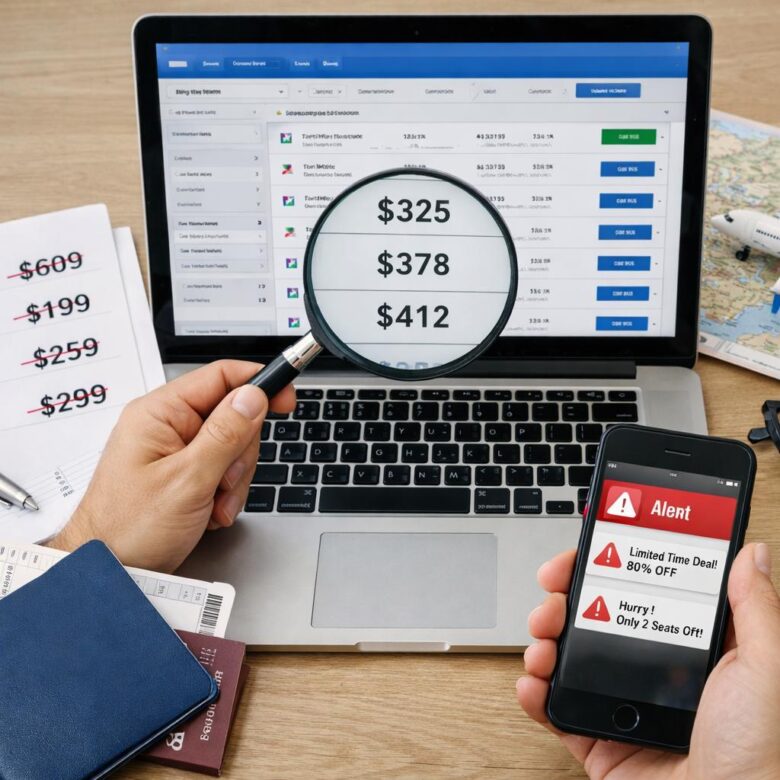
What if that “50% off” flight deal was never a deal at all?
Airfare pricing is designed to move fast, look urgent, and make ordinary fares feel like rare bargains. Flash sales, countdown timers, and “only 2 seats left” alerts can push travelers into booking before they compare the numbers.
Finding better flight deals is not about chasing every discount banner. It is about knowing when prices are genuinely low, spotting inflated “was” prices, and using the right tools without getting trapped by misleading offers.
This guide shows you how to separate real savings from fake discounts so you can book smarter, avoid pressure tactics, and pay less for flights with confidence.
What a Real Flight Deal Looks Like: Baseline Fares, Taxes, Fees, and “Fake” Markdowns
A real flight deal is not just a big percentage discount on a booking site. It is a fare that is meaningfully lower than the normal baseline price for that route, season, airline, and baggage policy. Before trusting a “limited-time sale,” compare the total airfare cost on tools like Google Flights, Skyscanner, or the airline’s own website.
The key is to look at the final checkout price, not the headline fare. Some cheap flight offers look attractive because the base fare is low, but taxes, carrier-imposed surcharges, seat selection fees, baggage fees, and payment charges push the real travel cost much higher. This is common on budget airlines, especially for short-haul routes in Europe, Asia, and domestic U.S. markets.
- Baseline fare: What the route usually costs for your travel dates.
- Total price: Fare plus taxes, fees, bags, seats, and add-ons.
- Flexibility value: Refundable tickets, change fees, and travel insurance benefits.
For example, a New York to Miami flight advertised at $79 may seem like a bargain. But if a carry-on costs extra, seat selection adds another charge, and the return flight is expensive, a $145 full-service airline ticket may be the better flight deal. I’ve seen travelers overpay simply because they compared one-way teaser fares instead of round-trip totals.
Watch out for “fake” markdowns where a site shows a crossed-out price that was never realistic for your dates. A better method is to track airfare for a week or two, check nearby airports, and compare cash prices with credit card travel portal rates or airline miles redemptions. Real savings survive comparison.
How to Compare Airfare Prices Accurately Across Booking Sites, Airlines, and Flexible Dates
To compare airfare prices properly, start with the “total trip cost,” not the headline fare. A $39 flight can become more expensive than a $79 ticket once you add seat selection, carry-on baggage fees, checked luggage, payment fees, and airport transfer costs.
Use Google Flights as your baseline because it shows flexible date pricing, fare history, nearby airports, and airline booking options in one place. Then cross-check the same route on the airline’s official website, Skyscanner, or an online travel agency such as Expedia to see whether the lower fare has restrictions or missing benefits.
- Match the details: same dates, flight number, baggage allowance, cabin class, and refund policy.
- Check flexible dates: flying one day earlier or later can reduce airfare costs, especially on Tuesdays, Wednesdays, or Saturdays.
- Compare final checkout prices: some booking sites show taxes late or add service fees before payment.
For example, I’ve seen a “cheaper” third-party fare for a New York to Miami flight become less attractive after adding a carry-on bag and paid seat assignment. The airline’s direct booking cost slightly more upfront but included easier changes, better customer service, and clearer travel insurance options.
Also compare nearby airports when practical. Searching Newark, JFK, and LaGuardia together-or checking both LAX and Burbank-can reveal better flight deals without relying on fake discounts or misleading limited-time offers.
Advanced Flight Deal Strategies: Fare Alerts, Price History Tools, and Mistakes That Lead to Overpaying
Smart flight shopping starts before you’re ready to book. Set fare alerts on Google Flights, Kayak, or Hopper for specific routes, then watch the price history instead of trusting a “limited-time deal” banner. If a New York to Lisbon fare usually sits around the same range for weeks, a small markdown may not be a real discount.
Use price tracking tools to compare nearby airports, flexible dates, and cabin classes. I’ve seen travelers save more by flying out on a Tuesday from a secondary airport than by waiting for a flash sale from the main hub. Also check total trip cost: baggage fees, seat selection, airport transfers, and travel insurance can erase the savings from a cheap base fare.
- Don’t book too fast: verify the fare on the airline’s official website before paying an online travel agency.
- Don’t ignore fare rules: basic economy tickets may block changes, refunds, and carry-on bags.
- Don’t rely on one app: compare Google Flights, Skyscanner, and the airline directly for the final price.
A useful habit is to screenshot good fares with dates, route, baggage policy, and payment total. That makes it easier to spot when a “deal” is just the same airfare repackaged with higher service fees. The best flight deals are not always the cheapest headline prices; they’re the ones with the lowest real cost and the fewest expensive restrictions.
Summary of Recommendations
Finding a real flight deal is less about chasing the biggest discount and more about knowing what a fair fare looks like. Use price history, compare total costs, and question urgency-based offers before booking.
- If the final price matches or beats recent averages, it may be worth taking.
- If fees, poor routing, or strict conditions erase the savings, walk away.
- If a deal feels rushed or unclear, verify it through trusted booking channels first.
The best decision is not the cheapest ticket on paper, but the one that offers genuine value for your route, timing, and flexibility.